Between Containment and Crossing
Bhajan Hunjan's work has always operated between positions; interior reflection and shared experience, structure and freedom, figuration and abstraction. Working across painting, printmaking and later in the public realm, her practice has perhaps always been less about representation and more about evoking an atmosphere, inner landscape and how we can be present in the environment around us, an environment that is not always benign.
Born in Kenya to Indian parents with a Sikh heritage, Hunjan's trajectory is part of a wider history of migration shaped by empire and postcolonial structures. She has spoken about growing up in a culture of making, introduced to textiles and claypot making by her mother and more practical making by her father and wider family who ran a hardware shop. "'Making' was our pleasure, our entertainment, our life," Hunjan has said. It is tempting to read this background into the surface of her paintings and works on paper, where form is built, layered and held together. The surfaces of Hunjan's works are never merely a ground for imagery but might instead be understood a sites of assembly.
Arriving in Britain in the late 1970s to study for a Fine Arts degree at Reading University was both a geographic and personal transition. Hunjan has described this as both a moment of freedom and empowerment. At art school she encountered a curriculum dominated by Western abstraction, encouraging internal exploration while offering few cultural points of identification. Independent research lead her to a practice that was grounded in lived experience as much as the legacy of modernism that was being taught at art school. Technical processes, such as printmaking and ceramics, became grounding tools through which she could think materially. Early works explored organic forms; seeds, eggs and branching structures addressing regeneration and belonging while searching for a language capable of holding multiple inheritances.
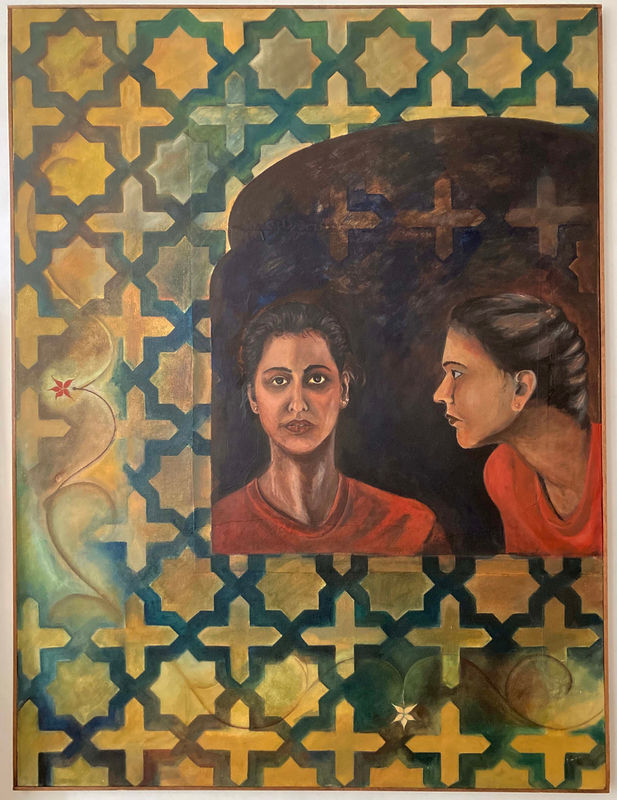
Most significant however, was the work Hunjan undertook for a group that was establishing a refuge for women experiencing domestic violence, a project that she was involved with for around five years. This lead to a shift in Hunjan's practice, "It gave me huge political insight and led to a shift in my aesthetics. I realised the value of portraiture in telling the stories of these women - their bodies told the stories." For Hunjan then, portraiture became a way of witnessing. Bodies carried stories that language could not always articulate. From the early 1980s onward her paintings frequently present female figures partially screened, divided or doubled. Grids and decorative patterns cross or enclose faces and figure, canvases are split into opposing zones.
These painterly strategies function to produce an ambivalence; they are protective and restrictive at the same time. They might be read as suggesting cultural frameworks, domestic interiors or psychological boundaries, or more persuasively all these at the same time. Rather than straightforward portraiture, these works operate as psychological spaces in which memory, cultural inheritance and lived experience overlap.
Hunjan's work has pursued a consistent question: how can visual culture communicate across difference and lived experience. Her answer is neither narrative nor didactic. Activism emerges through attentiveness and emotional precision rather than declaration in comparison to contemporaries who in the 1980s and early 1990s pursued more direct political imagery. The paintings and works on paper from this period create reflective spaces in which viewers recognise conditions shaping everyday life; care, endurance, expectation and self-negotiation. This reflective quality extends to the act of looking itself. In several works the subject confronts her own image, establishing a doubled presence. The psychological centre often lies in the space between figures, where patterned surfaces mediate relationships. Pattern becomes a social language, articulating enclosure, connection and distance.
During this period Hunjan also worked collectively, with the Open Hand Studios in Reading and notably as a founding member of Panchayat, a group dedicated to promoting South Asian artists through exhibitions, workshops and public education. Their 1992 exhibition Crossing Black Waters referenced the idea of kala pani, the notion that travelling across seas meant separation from community. The concept resonates across Hunjan's practice; identity is never singular and fixed but always something that is in process and formed through crossings, negotiations and returns. The recurring divisions within her works can be understood not simply as barriers but as thresholds.
By the early 1990s figuration began to loosen. Colour, pattern and spatial rhythm increasingly carried the emotional work once held by the body. Meaning migrated from subject to structure, structures becomes memory, colour becomes atmosphere, and line becomes a gesture of containment. Rather than abandoning earlier concerns, the subsequent work in the 1990s and 2000s, much in the public sphere, distils them. The recent embroidered works extend this trajectory materially. What appeared as drawn grids and decorative motifs in earlier paintings is now literally constructed through thread. Time, touch and labour are made manifest and the act of making becomes physically present.
For Hunjan, making has always been inseparable from thinking. In the paintings and works on paper of the 1980s and early 1990s, we encounter introspective figures who are doubled, partially screened or quietly self-contained, all held within carefully structured spaces of colour and pattern. Recent institutional attention, including her shortlisting for the Max Mara Art Prize for Women and inclusion in Women in Revolt! Art and Activism in the UK 1970-1990 at Tate Britain has brought renewed visibility to this body of work, situating it more clearly within the histories of British art and feminist practice to which it has long contributed.
For further information please contact:
Georgia Griffiths
georgia@niruratnam.com
